
From Data to Decisions. Why Great Analytics Starts with the Right Business Question
"We cannot solve our problems with the same thinking we used when we created them." — Albert Einstein
Businesses today have more data than ever before. Website analytics, CRM systems, social media platforms, customer surveys, sales reports, AI-generated insights, the amount of information available can feel overwhelming.
Yet despite having access to all this data, many organisations still struggle to answer a simple question:
How do we turn data into better business decisions?
This is where many analytics projects go wrong. Companies often start with the technology, the dashboards, or the AI models before they clearly understand the business problem they are trying to solve.
At Luciqo AI, we believe that successful analytics isn't about collecting more data. It's about understanding the right problem, extracting meaningful insights, and turning those insights into actions that create real business value.
Let's explore how that process works.
Analytics Doesn't Solve Problems. People Do.
One of the biggest misconceptions in data analytics is believing that analytics itself solves business problems.
It doesn't.
A predictive model won't increase sales.
A dashboard won't improve customer retention.
An AI algorithm won't magically create business growth.
What these tools do is provide insights that help people make better decisions.
Imagine a company that wants to increase revenue.
The business problem is:
"We need to sell more products."
An analytics model cannot directly sell anything.
However, it might identify:
- Which customers are most likely to buy.
- Which products are most likely to be purchased together.
- Which marketing campaigns generate the highest conversions.
- Which customers are at risk of leaving.
These insights allow decision-makers to take action.
The result isn't better because of the model itself. The result is better because the organisation uses the insight to make smarter decisions.
This distinction is critical.
Analytics creates understanding. People create outcomes.
Start with the Business Problem, Not the Data
Many organisations make the mistake of starting with questions like:
- What data do we have?
- What reports can we build?
- What AI tools should we use?
- Which dashboard platform should we buy?
These are important questions, but they shouldn't come first.
The first question should always be:
What business problem are we trying to solve?
For example:
- Customer churn is increasing.
- Marketing costs are rising.
- Sales conversion rates are falling.
- Customer acquisition is becoming more expensive.
- Lead quality is inconsistent.
Once the problem is clearly defined, the analytics process becomes much easier.
Without a clearly defined problem, even the most sophisticated analytics project can fail because nobody knows what success looks like.
At Luciqo AI, this principle is at the heart of every analysis we perform.
Before analysing data, we focus on understanding:
- The business objective.
- The desired outcome.
- The decisions that need to be made.
Only then do we look at the data.
The Journey from Data to Decisions
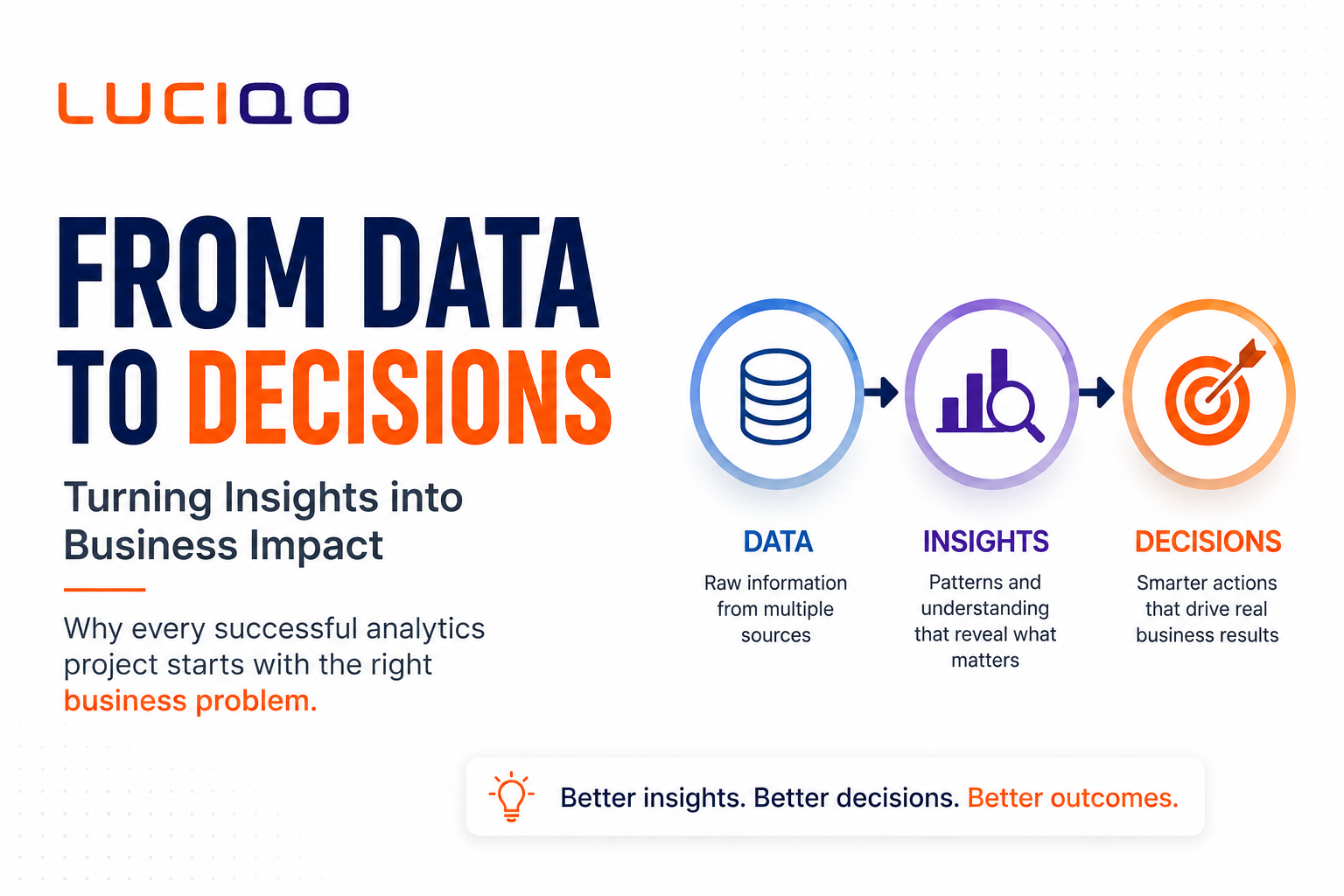
A useful way to think about analytics is as a journey with three stages:
1. Data
This is the raw information collected from different systems.
Examples include:
- Website traffic
- CRM records
- Sales transactions
- Customer interactions
- Advertising performance
- Search behaviour
- AI visibility data
By itself, data has limited value.
Thousands of rows in a spreadsheet don't automatically tell a story.
2. Insights
Insights are patterns, trends, and relationships discovered within the data.
For example:
- Prospects from LinkedIn convert at twice the rate of Facebook leads.
- Returning customers spend 35% more than first-time buyers.
- Customers who visit specific pages are more likely to enquire.
- AI platforms mention competitors more frequently than your brand.
This is where analytics starts to become valuable.
Insights help explain what is happening and why.
3. Decisions
Insights only become valuable when they influence decisions.
For example:
- Increase investment in LinkedIn campaigns.
- Create more content around high-converting topics.
- Improve customer onboarding processes.
- Optimise visibility within AI-generated search results.
The ultimate goal of analytics is not reporting.
The goal is better decisions.
Understanding How the Business Works
A common mistake among analysts is focusing exclusively on the numbers while ignoring the business context behind those numbers.
Data without context can be misleading.
For example, imagine a healthcare organisation.
A data analyst may see a record labelled "member."
Someone unfamiliar with the industry might assume this refers to a loyalty programme member.
In reality, it may refer to a policyholder.
The terminology matters.
Understanding how a business operates helps analysts:
- Ask better questions.
- Interpret data correctly.
- Build more accurate models.
- Communicate findings effectively.
This concept is often referred to as business understanding or domain knowledge.
The most successful analysts aren't necessarily those with the strongest technical skills.
Often, they are the people who understand both the data and the business.
Defining the Right Analytics Solution
Once the business problem is clear, the next step is deciding how analytics can help solve it.
There is rarely only one solution.
Consider a company experiencing declining sales.
Several analytics approaches might be possible:
Solution 1: Customer Churn Prediction
Identify customers who are likely to leave before they stop buying.
Solution 2: Lead Scoring
Prioritise prospects most likely to convert.
Solution 3: Persona Intelligence
Understand which audience segments have the strongest purchase intent.
Solution 4: Marketing Attribution
Identify which channels generate the highest-value customers.
Each solution addresses the same business challenge from a different angle.
The goal is to identify the approach that provides the most practical value.
This is exactly why Luciqo AI focuses on persona intelligence, intent analysis, and audience understanding.
Businesses rarely suffer from a lack of data.
More often, they suffer from a lack of clarity about which data matters most.
Why AI Needs Business Context
Artificial intelligence has transformed how organisations analyse information.
However, AI is only as effective as the problem it is asked to solve.
If the business objective is unclear, AI simply produces more sophisticated confusion.
For example:
An AI model might discover hundreds of patterns within customer data.
But which patterns matter?
Without understanding the business goal, it's impossible to know.
This is why human expertise remains essential.
The most effective AI systems combine:
- Data
- Machine learning
- Business understanding
- Human judgement
At Luciqo AI, we view artificial intelligence as an amplifier of human decision-making, not a replacement for it.
AI should help organisations move faster from data to insight and from insight to action.
The Future Belongs to Insight-Driven Businesses
The organisations that succeed over the next decade won't necessarily be the ones with the most data.
They will be the ones that are best at turning data into decisions.
That requires more than dashboards.
It requires:
- Understanding business challenges.
- Asking the right questions.
- Identifying meaningful patterns.
- Translating insights into actions.
- Continuously learning from outcomes.
This is where data intelligence becomes a competitive advantage.
Businesses that can consistently convert information into decisions will outperform those that simply collect information.
Final Thoughts
The journey from data to decisions is not about technology alone.
It starts with understanding the business problem.
It continues with uncovering meaningful insights.
And it succeeds when those insights lead to better decisions.
Whether you're trying to improve marketing performance, understand customer behaviour, increase conversions, or strengthen your visibility in AI-generated search results, the same principle applies:
Don't start with the data. Start with the decision you need to make.
At Luciqo AI, that's exactly how we approach intelligence.
Not as a collection of reports, dashboards, or algorithms—but as a way to help businesses understand their audience, identify opportunities, and make better decisions with confidence.
Because data is only valuable when it helps you decide what to do next.
Ready to go?
Book a demo with our team to see how Luciqo measures your brand in AI.