
How Is Luciqo AI Different From Semrush?
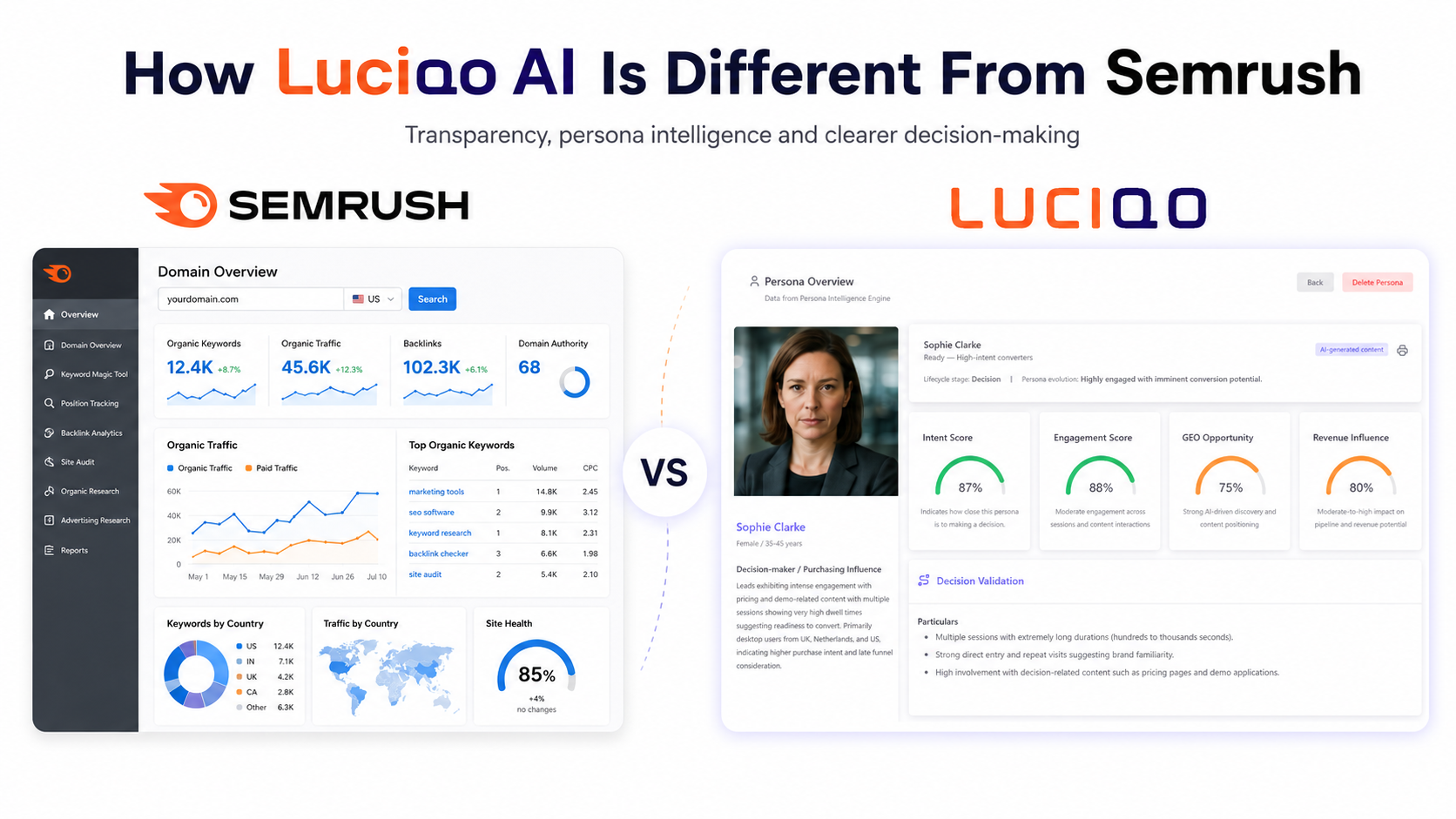
Semrush and Luciqo AI both help businesses understand digital visibility, competition and emerging AI-search performance.
However, they are built for different purposes.
Semrush is a broad SEO and digital marketing platform. Its principal strength is the scale of its search, keyword, backlink, traffic and competitor data.
Luciqo AI is a marketing intelligence platform focused on helping businesses understand how AI platforms perceive, mention and recommend their brands, while connecting those findings with reputation, audience intent, personas and business data.
The most important difference is not simply the number of features each platform offers.
It is the way the platforms explain their findings, show their evidence and help users distinguish between measured data, modelled estimates and AI-generated interpretation.
Semrush is built around search data
Semrush has developed one of the largest ecosystems in digital marketing.
It provides tools for:
- Keyword research
- Competitor analysis
- Backlink monitoring
- Technical SEO
- Position tracking
- Paid search research
- Content optimisation
- Traffic estimation
- AI visibility monitoring
For SEO professionals and agencies, this breadth is valuable.
Semrush can help a team understand where a website ranks, which competitors are gaining visibility, what keywords may create opportunities and where technical improvements are required.
Its newer AI-search tools also help businesses monitor mentions, citations, sentiment and visibility across generative search experiences.
However, Luciqo AI approaches the problem from a different direction.
Luciqo AI is designed as an intelligence layer
Luciqo does not aim to replicate every SEO function available in Semrush.
Instead, it focuses on connecting multiple signals to help businesses answer more strategic questions.
These include:
- How are AI platforms describing our brand?
- Are they recommending us or our competitors?
- What evidence appears to influence those recommendations?
- Which sources are shaping our digital reputation?
- Which audiences show stronger commercial intent?
- What concerns, motivations and behaviours influence those audiences?
- Which actions should the business prioritise?
This makes Luciqo particularly relevant for founders, marketing leaders, agencies and commercial teams that need interpretation rather than another isolated reporting dashboard.
The difference between data and interpretation
One of the greatest challenges in AI-powered analytics is understanding where the data ends and the interpretation begins.
A platform may display a sentiment score, visibility score, recommendation score or AI-generated summary. However, users also need to understand:
- Which sources were analysed
- Which prompts were used
- When the analysis was conducted
- Which AI platform produced the result
- Whether the result came from observed evidence or modelled estimation
- How the score was calculated
- Whether the conclusion can be independently checked
Without this context, an apparently precise score may be difficult to validate.
This does not necessarily mean that the data is incorrect. It means that the user may not have enough visibility into the process behind the conclusion.
Luciqo AI is designed to reduce this ambiguity.
Luciqo places greater emphasis on traceability
Luciqo aims to show users the evidence behind its analysis.
Rather than relying only on a top-level score, it can connect findings to the prompts, mentions, sources, citations and brand signals that contributed to the result.
This helps users distinguish between:
- Directly observed brand mentions
- Source-based reputation signals
- Sentiment interpretation
- Competitive comparisons
- AI-generated recommendations
- Strategic conclusions produced by the platform
This level of traceability is important because AI-generated analysis can sound highly confident even when the underlying evidence is incomplete.
A business should be able to inspect the reasoning behind a recommendation rather than being expected to accept a score without context.
Why AI-generated analysis requires caution
Any platform using large language models can produce outputs that appear convincing but may contain incomplete interpretations, incorrect associations or unsupported conclusions.
This is commonly described as AI hallucination.
The risk is especially relevant when a system produces narrative summaries from large datasets.
For example, an AI system may:
- Associate a review with the wrong business
- Interpret an unrelated mention as relevant
- Overstate the meaning of a small sample
- Present an estimated metric as though it were directly measured
- Generate a confident explanation without sufficient supporting evidence
- Misinterpret sarcasm, ambiguity or mixed sentiment
- Combine separate sources into a conclusion that none of them explicitly supports
This risk does not apply only to Semrush. It applies to any AI-enabled analytics platform.
The meaningful difference is how each platform manages and communicates that risk.
Luciqo is designed to make uncertainty visible
Luciqo’s approach is to make the origin and reliability of findings clearer.
Where possible, users should be able to see:
- The source behind the insight
- The prompt that triggered the result
- The AI platform where the brand appeared
- The date of the analysis
- The context in which the brand was mentioned
- Whether the finding is directly observed or inferred
- The factors contributing to a score
- The confidence or limitation of the analysis
This supports more responsible decision-making.
Instead of presenting every AI-generated conclusion as an absolute fact, Luciqo aims to help users understand the strength of the evidence behind it.
A score without context has limited value
Marketing platforms increasingly use proprietary scoring systems.
These may include:
- Visibility scores
- Brand presence scores
- Sentiment scores
- Reputation scores
- Authority scores
- Recommendation scores
These indicators can be useful for monitoring trends.
However, they become less useful when the user cannot see what caused the score to rise or fall.
For example, a reputation score of 62% may appear precise, but the business still needs to know:
- Which sources influenced it
- Whether the score is based on five mentions or five thousand
- Whether reviews were correctly attributed
- Whether the system excluded irrelevant content
- Whether the result reflects current or historical evidence
- Which actions would meaningfully improve it
Luciqo is designed to connect the score with diagnostic information and recommended actions.
The aim is not merely to tell a business that its score is low.
The aim is to explain why it is low, what evidence supports that conclusion and what the business should do next.
Luciqo goes beyond AI mention counting
Counting brand mentions and citations is useful, but it is not enough.
A brand may appear frequently in AI-generated answers without being positively recommended.
It may also be mentioned for irrelevant topics, cited through weak sources or described in language that creates reputational risk.
Luciqo therefore examines the wider context around visibility.
This includes:
- How the brand is positioned
- Which competitors appear alongside it
- Whether the brand is recommended
- Which attributes AI platforms associate with it
- Which sources support those associations
- Whether the narrative is positive, negative or uncertain
- Whether the mentions align with the company’s actual market positioning
This helps businesses move from simple visibility tracking to reputation and recommendation intelligence.
Luciqo connects AI visibility with audience intent
Another significant difference is Luciqo’s emphasis on personas and buying intent.
Semrush is highly effective at analysing search demand, keywords and competitors.
Luciqo adds a layer focused on understanding who may be behind those searches and what may influence their decisions.
Its intelligence can help businesses explore:
- Audience motivations
- Customer concerns
- Decision triggers
- Buying barriers
- Funnel stages
- High-intent segments
- Persona-level opportunities
- Changes in audience behaviour
This is particularly valuable where marketing teams need to understand not only what people are searching for, but why they are searching and how close they may be to taking action.
Luciqo connects visibility with business outcomes
Semrush is strongest when the principal question is:
How is our brand performing across search?
Luciqo is designed to answer a broader commercial question:
What does our visibility mean for reputation, audience intent and business growth?
By connecting AI-search findings with analytics, CRM and marketing data, Luciqo can help businesses investigate whether visibility is contributing to:
- Higher-quality leads
- Increased engagement
- Greater brand trust
- Improved conversion
- Stronger campaign performance
- More efficient marketing investment
- Better sales prioritisation
This helps move the analysis beyond rankings and mentions.
Luciqo provides more focused recommendations
A large platform can produce a substantial volume of metrics, reports and alerts.
However, more data does not always create more clarity.
Luciqo is designed to prioritise the signals that are most relevant to the organisation’s objectives.
Its recommendations can focus on actions such as:
- Improving weak brand narratives
- Correcting inaccurate information
- Strengthening authoritative third-party sources
- Addressing reputation gaps
- Creating content for high-intent questions
- Improving visibility for commercially relevant prompts
- Aligning messaging with audience concerns
- Prioritising the competitors and topics that matter most
The emphasis is on turning intelligence into action rather than leaving the user to interpret a large collection of disconnected metrics.
Transparency is not the same as simplicity
A transparent platform does not need to expose every part of its technical architecture or proprietary algorithm.
However, it should give users enough information to evaluate the reliability of the result.
This means clearly separating:
- Verified observations
- Calculated metrics
- Modelled estimates
- AI-generated interpretations
- Strategic recommendations
Luciqo is being developed around this principle.
The objective is to give businesses clearer visibility into how conclusions were formed and to avoid presenting AI-generated interpretation as unquestionable fact.
Does Luciqo AI replace Semrush?
For many organisations, Luciqo and Semrush can be complementary.
Semrush remains valuable for:
- Detailed keyword research
- Backlink analysis
- Technical SEO
- Search-volume analysis
- Competitor domain research
- Position tracking
- Large-scale SEO workflows
Luciqo adds a different intelligence layer focused on:
- AI brand visibility
- Brand recommendation
- Reputation intelligence
- Source-level evidence
- Persona development
- Intent scoring
- Audience interpretation
- Commercial decision support
A specialist SEO team may continue using Semrush for deep search intelligence while using Luciqo to connect that intelligence with reputation, audiences and business priorities.
How the pricing compares
Luciqo AI is structured to provide different levels of intelligence depending on the organisation’s requirements.
Its current plans include:
- Insight: Free
- Signal: £149 per month
- Intelligence: £399 per month
- Horizon: Custom enterprise pricing
The free Insight plan provides an accessible entry point for businesses that want to examine their AI visibility and brand presence.
Signal is designed for organisations that require more consistent monitoring, risk identification and opportunity analysis.
Intelligence adds deeper reputation analysis, persona intelligence and intent scoring.
Horizon is intended for more advanced integrations, custom data sources and enterprise intelligence requirements.
Semrush pricing varies according to the toolkits, usage limits, users and level of access selected. Its broader plans may be appropriate for teams that require extensive SEO functionality, while Luciqo may provide a more focused investment for organisations primarily interested in AI visibility, reputation and audience intelligence.
The principal Luciqo advantage
The strongest Luciqo advantage is not that it produces more data than Semrush.
It is that Luciqo is designed to make AI intelligence more understandable, traceable and commercially relevant.
It seeks to show businesses:
- What was observed
- Where it was observed
- Which evidence supports the conclusion
- What remains uncertain
- How the insight relates to audiences
- What action should follow
This approach is increasingly important as AI-generated summaries, scores and recommendations become more common.
Businesses should not have to choose between sophisticated AI analysis and transparency.
They should expect both.
Final assessment
Semrush is a powerful and established platform for SEO, search visibility and competitive research.
Its growing AI capabilities make it increasingly useful for monitoring brand mentions, citations and performance across AI-powered search experiences.
Luciqo AI is different because it is built around transparency, interpretation and business decision-making.
Rather than focusing only on whether a brand appeared, Luciqo aims to explain:
- Why it appeared
- How it was described
- Whether it was recommended
- Which sources influenced the result
- How reliable the conclusion may be
- Which audiences are most relevant
- What the business should do next
The central difference is therefore not Semrush versus AI.
Both platforms use AI.
The difference is between broad search intelligence and a more transparent, audience-led commercial intelligence layer.
For organisations that need deep SEO data, Semrush remains a strong platform.
For organisations that want clearer evidence, greater traceability and stronger connections between AI visibility, reputation, audience intent and business outcomes, Luciqo AI offers a distinct alternative.
Ready to go?
Book a demo with our team to see how Luciqo measures your brand in AI.