
The Buyer Journey Is Changing. Soon AI Agents Will Compare, Decide, and Purchase for Customers.
The End of the Traditional Buyer Journey?
For decades, marketers have relied on a relatively predictable customer journey:
Awareness → Consideration → Evaluation → Purchase → Loyalty
A customer would discover a brand through advertising, search engines, social media, recommendations, or direct outreach. They would research options, compare competitors, read reviews, visit websites, and eventually make a purchase decision.
This model shaped entire industries. Marketing teams invested heavily in SEO, paid search, content marketing, social media, email campaigns, conversion rate optimisation, and customer experience to influence human buyers at each stage of the funnel.
But a fundamental shift is underway.
The rise of AI assistants, AI search engines, and autonomous purchasing agents is creating a new reality where customers may no longer be the primary decision-makers.
Instead, AI will increasingly become the decision-maker on behalf of customers.
The implications for businesses are profound.
How Buying Decisions Worked Before
Historically, businesses competed for human attention.
Success depended on being visible where humans searched and consumed information:
- Google Search
- Social media platforms
- Online reviews
- Comparison websites
- Industry publications
- Influencer recommendations
The goal was simple:
Get your brand in front of a person and persuade them to choose you.
Marketing teams focused on:
- Search rankings
- Website traffic
- Click-through rates
- Brand awareness
- Conversion optimisation
- Lead generation
The customer controlled the research process.
Even when recommendations came from Google or social platforms, the final decision was still made by a human.
What Is Happening Now?
The emergence of AI-powered assistants is changing how information is discovered and evaluated.
Consumers are increasingly asking AI systems questions such as:
- "What is the best CRM for a small business?"
- "Which university offers the best online MBA in healthcare management?"
- "What protein supplement is most trusted by athletes?"
- "Which cybersecurity platform offers the best value?"
Instead of reviewing ten websites, reading five articles, and comparing multiple vendors, users increasingly receive a single AI-generated answer.
The first disruption was AI Search.
The second disruption will be AI Agents.
The Next Phase: AI Agents Will Act on Our Behalf
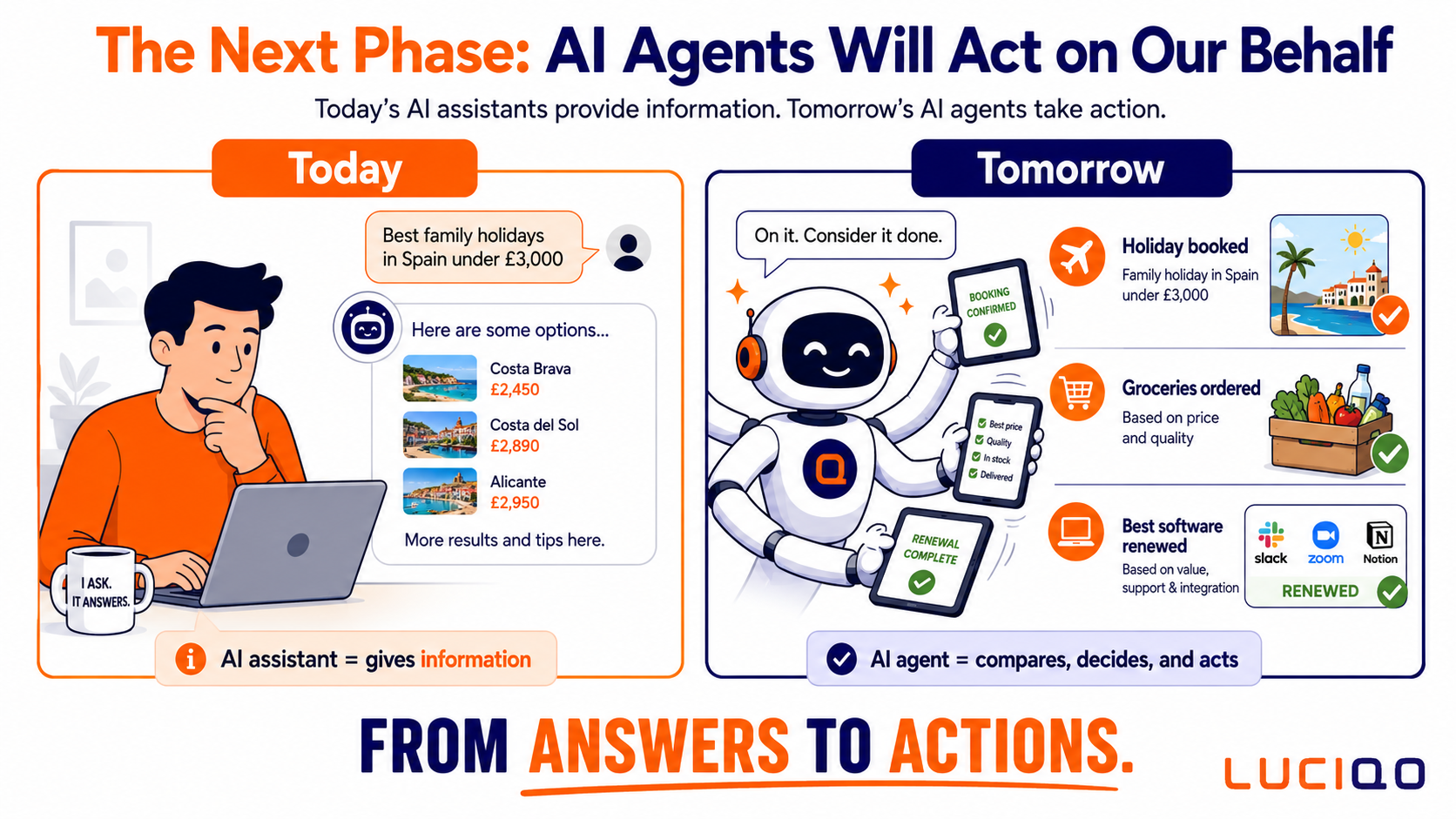
Today's AI assistants primarily provide information.
Tomorrow's AI agents will take action.
Imagine telling your AI assistant:
"Find the best family holiday in Spain under £3,000 and book it."
Or:
"Order my weekly groceries from the supermarket offering the best combination of price and quality."
Or:
"Renew my business software subscriptions and choose the best provider based on value, support, and integration capabilities."
The AI agent will:
- Understand the objective.
- Research available options.
- Compare competitors.
- Evaluate reviews and reputation.
- Consider pricing and value.
- Make a recommendation.
- Complete the purchase.
The human remains the owner of the decision framework, but the agent performs the work.
This is known as Agentic Commerce.
Why This Changes Everything for Marketing
Traditional marketing was designed to influence people.
Future marketing must influence both people and machines.
Businesses will no longer compete solely for human attention.
They will compete for AI recommendation.
The critical question becomes:
When an AI agent evaluates your category, does your brand appear as a recommended option?
If the answer is no, your visibility problem becomes a revenue problem.
AI agents will increasingly favour brands that demonstrate:
- Strong reputation signals
- Consistent brand messaging
- Trustworthiness
- Positive customer sentiment
- Transparent pricing
- Reliable product information
- Strong digital authority
In other words, AI systems will reward businesses with clear, credible, and structured digital footprints.
The New Buyer Journey
The future buyer journey may look more like this:
Traditional Model
Awareness → Consideration → Evaluation → Purchase
Agentic Model
Need Identified → AI Research → AI Comparison → AI Recommendation → AI Purchase
Notice what is missing.
Many of the traditional touchpoints disappear.
Customers may never visit your website.
They may never see your advertisement.
They may never compare five competitors manually.
The AI agent becomes the intermediary.
What AI Agents Will Evaluate
As AI purchasing systems mature, they will likely assess brands across multiple dimensions.
Reputation
What are customers saying?
Is sentiment positive or negative?
Are there recurring complaints?
Visibility
How often does the brand appear across AI-generated responses?
Is it consistently recommended?
Authority
Is the business recognised as a credible source?
Does it demonstrate expertise?
Customer Experience
What do reviews reveal?
How responsive is the organisation?
Value
Does the offering provide measurable benefits relative to cost?
Trust
Are security, privacy, and compliance standards clearly demonstrated?
Businesses that perform well across these dimensions will be more likely to be recommended by AI systems.
What Businesses Should Do Now
Many organisations are still treating AI as a future challenge.
That is a mistake.
The foundations of AI recommendation are being built today.
Forward-thinking companies should focus on five areas.
1. Monitor What AI Is Saying About Your Brand
Most businesses track Google rankings.
Few track AI recommendations.
Yet customers are already asking AI systems for recommendations, comparisons, and buying advice.
Understanding how AI platforms represent your brand is becoming as important as understanding search rankings.
2. Strengthen Your Digital Footprint
AI systems rely on information from multiple sources.
This includes:
- Websites
- Reviews
- Social media
- Industry publications
- Forums
- News articles
- Community discussions
Consistency and credibility across these sources matter.
3. Build Trust Signals
Trust is becoming a machine-readable asset.
Businesses should ensure:
- Accurate company information
- Strong customer reviews
- Transparent policies
- Credible thought leadership
- Consistent messaging
4. Create Structured and Accessible Content
AI systems understand well-structured information more effectively.
Clear content, authoritative resources, FAQs, case studies, and educational material help AI systems understand and recommend your brand.
5. Develop an AI Visibility Strategy
Just as organisations developed SEO strategies over the past two decades, they now need strategies focused on AI discovery and recommendation.
The question is no longer:
"How do I rank on Google?"
It is becoming:
"How do I become the brand AI recommends?"
Where Luciqo AI Fits
The transition from human-led buying journeys to agent-led buying journeys creates a new challenge for businesses.
Companies need visibility into how AI systems perceive and represent their brand.
Luciqo AI was built to address this challenge.
Luciqo AI helps organisations:
- Track AI search visibility
- Monitor AI-generated brand recommendations
- Analyse brand perception
- Measure reputation signals
- Generate persona intelligence
- Identify intent patterns
- Detect reputation risks
- Integrate marketing, CRM, and analytics data
- Create tailored intelligence solutions for specific industries
As AI increasingly influences purchasing decisions, businesses need more than traditional analytics.
They need AI intelligence.
The Future Belongs to AI-Ready Brands
The shift toward agentic commerce will not happen overnight.
But it has already begun.
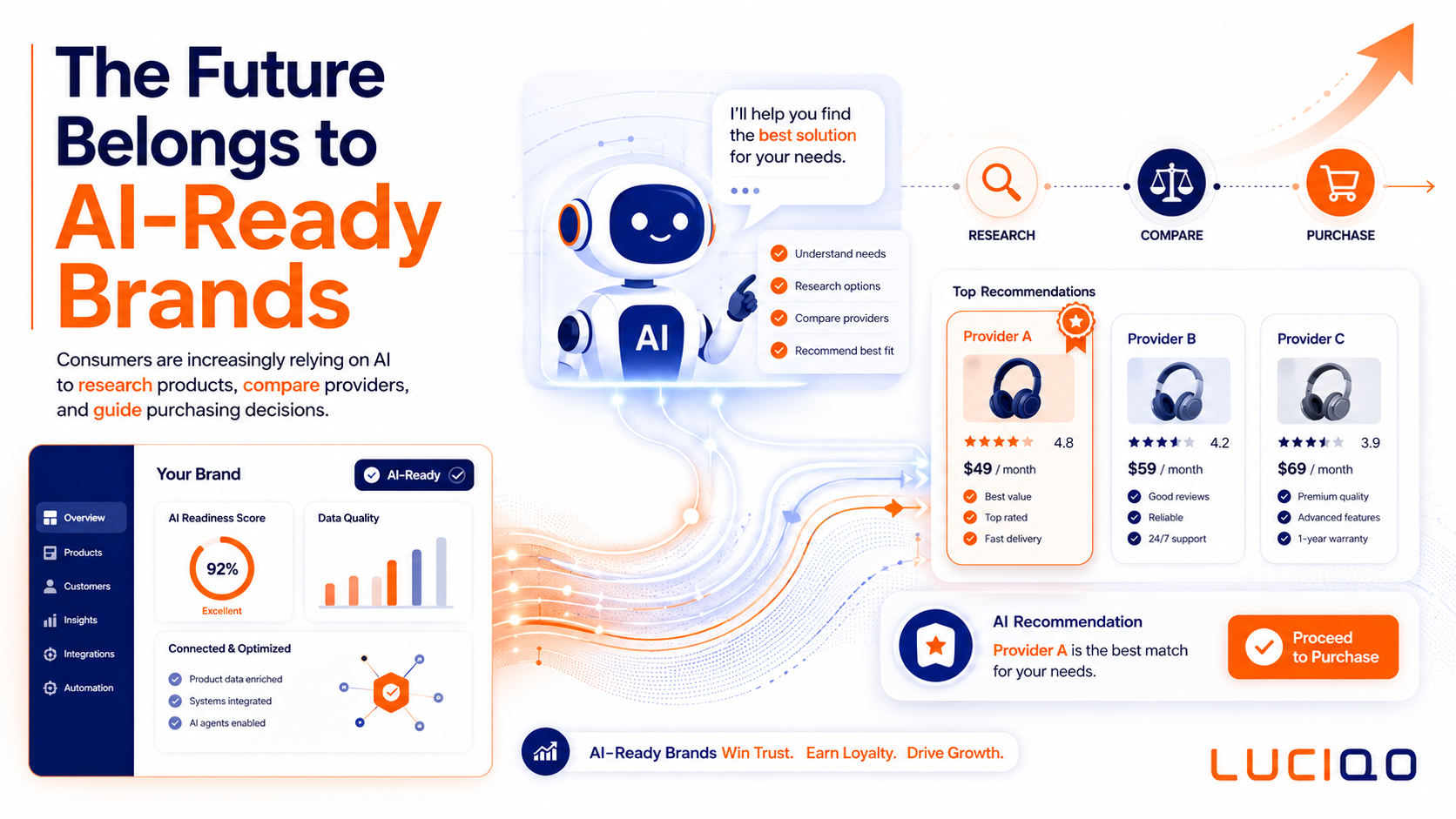
Consumers are increasingly relying on AI to research products, compare providers, and guide purchasing decisions.
The next step is obvious: allowing AI to complete those transactions.
The businesses that thrive will not simply optimise for search engines.
They will optimise for AI recommendation.
Because in the near future, your next customer may never visit your website.
Their AI agent will.
And that agent will decide whether your brand deserves to be chosen.
Ready to go?
Book a demo with our team to see how Luciqo measures your brand in AI.