
Why do citations and source credibility matter in AI answers?
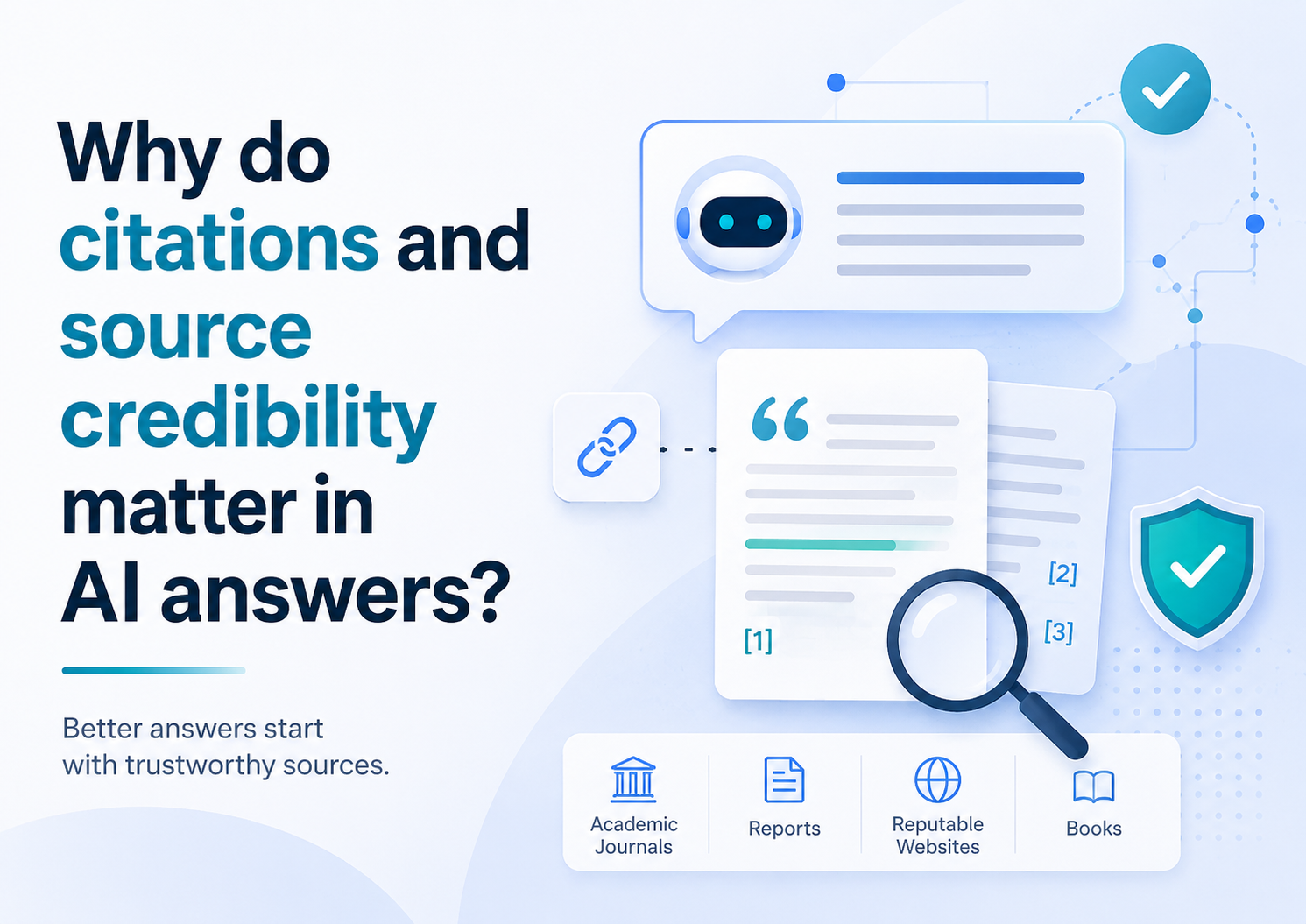
Citations in AI answers show where information comes from, so readers can verify claims and judge reliability. Without them, users are asked to trust a black box, which is risky, especially in complex or regulated topics. For marketing leaders, the presence and quality of citations are a practical signal of trust and accountability.
Strong source credibility matters as much as the citation itself. An obscure blog link does little to justify a medical or financial claim, while an official regulator or peer-reviewed source can change the risk profile. Luciqo.ai helps teams think clearly about how to make AI answers verifiable and useful for the right audience.
In higher-risk domains, poor sourcing is more than a UX issue, it can increase compliance and reputational exposure. For finance, UK rules expect communications with clients to be fair, clear, and not misleading, which is hard to evidence without transparent sourcing . If an AI answer touches personal data about individuals, the UK GDPR includes an accuracy principle, reinforcing the importance of factual correctness in how information is presented. For product or service claims, UK consumer law prohibits misleading commercial practices, so weakly sourced statements can be problematic.
Even outside regulated areas, citations help users compare alternatives, understand trade-offs, and see when recommendations rely on assumptions. They reduce internal debates by making the evidence visible.
Key evaluation criteria
1. Traceability and clarity of citations
Ask whether a reader can follow the chain of evidence from the claim back to a specific passage in a reliable source. Good citations point to stable URLs, include document titles, and, where helpful, anchor to sections or quotes. If the answer summarises a source, check that the summary matches the text and that context was not lost.
2. Authority, recency, and jurisdiction
Prioritise official bodies, regulators, standards organisations, and reputable publishers. Recency matters when guidance changes quickly, such as finance or medical topics. For UK audiences, prefer UK or UK-recognised authorities when claims depend on local rules or norms.
3. Relevance and claim-to-source alignment
A credible citation must support the exact claim, not a nearby idea. Watch for links that are on-topic but do not substantiate the statement made. When an AI cites multiple sources, check for consistency across them and call out any disagreements transparently.
Comparison with competitors
Different tools take different approaches. Some chat interfaces give fast answers without citations. They feel simple, but put the burden of trust entirely on the model and your brand. Others provide a list of links at the end, which is better, but can still leave readers guessing which source supports which claim.
More mature approaches tie each material statement to a specific reference, often using retrieval augmented generation. The trade-off is effort and potential latency, but the payoff is higher credibility and easier review. For leadership teams, the comparison comes down to speed versus verifiability, and whether the use case warrants line-of-sight to evidence.
Practical advice
Adopt a tiered sourcing policy that maps citation depth to topic risk. For everyday explainer content, link to reputable overviews. For product, medical, legal, financial, technical, or business-critical guidance, require primary or official sources, with clear attributions and dates.
- Define acceptable source tiers, for example official regulator or standard, academic or professional body, major news or publisher, then vendor content.
- Require a claim-to-source map in higher-risk outputs, so reviewers can audit quickly.
- Prefer UK authorities for UK audiences when rules or norms differ by jurisdiction.
- Handle paywalled or proprietary sources by including citation metadata and a short supporting quote where allowed.
- Monitor freshness for time-sensitive topics and recheck links on a schedule.
Common pitfalls include citing an article that merely mentions a concept, relying on outdated guidance, or using a brand blog to substantiate regulated claims. To discuss what this looks like in practice for your team, Learn more at Luciqo.ai.
How Luciqo.ai can help
Luciqo.ai can help organisations clarify when citations are essential, what sources meet your bar for credibility, and how to align depth of evidence with audience and risk. We can support teams with editorial frameworks, review workflows, and guidance to help AI answers stay verifiable and useful.
We do not assume one right answer. Some use cases need speed, others need formal sourcing. Luciqo.ai can help you weigh those trade-offs and set policies that your teams can actually follow.
Citations in AI answers make evidence visible, improve trust, and reduce risk. In UK contexts, they also help demonstrate clear, fair, not misleading communications and respect for accuracy where personal data is involved.
Focus on traceability, authority, and claim-to-source alignment, and scale your citation requirements to the risk of the topic. If you want practical help shaping a workable policy, Luciqo.ai is ready to talk.
Ready to go?
Book a demo with our team to see how Luciqo measures your brand in AI.