
Why Fragmented Marketing Data Is Holding Businesses Back and How Luciqo AI Turns It Into Action
Most businesses today are not short of data.
In fact, many have more data than they know what to do with.
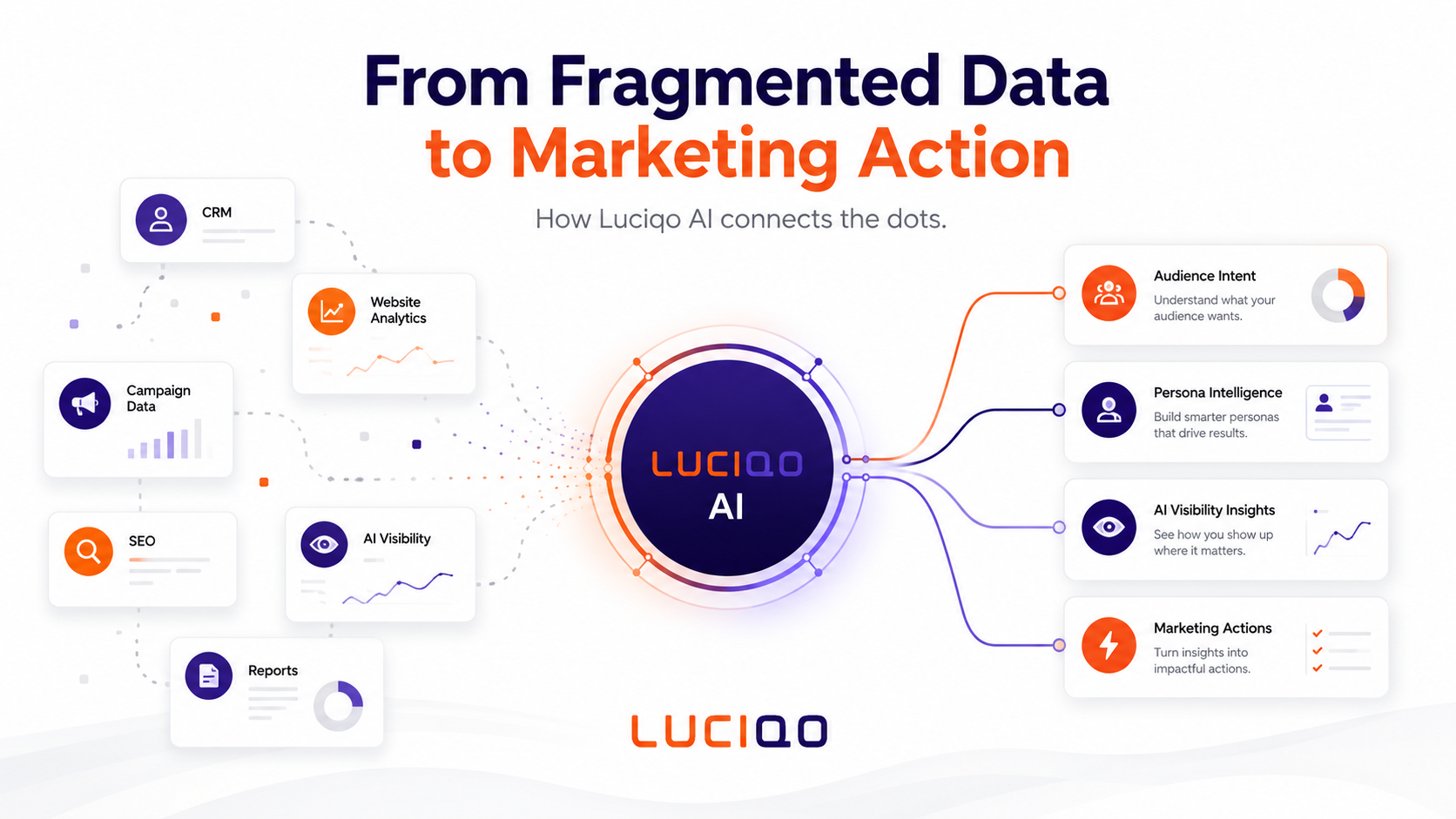
There is CRM data showing leads, contacts, sales opportunities and customer relationships. There is website analytics data showing traffic, engagement, conversions and user behaviour. There are campaign reports from email, paid media, social media, SEO and content activity. There are search visibility reports, keyword reports, sales reports and performance dashboards.
And now, there is a new layer of marketing intelligence to consider: how brands are being seen, mentioned and recommended across AI platforms such as ChatGPT, Gemini, Perplexity and Google AI Overviews.
- The challenge is no longer simply collecting data.
- The real challenge is connecting it, interpreting it and turning it into practical marketing action.
- This is the problem Luciqo AI has been designed to solve.
The problem: marketing data is everywhere, but clarity is missing
Many marketing teams operate with fragmented systems.
- CRM data sits in one platform.
- Website analytics sit in another.
- Campaign reports are stored somewhere else.
- SEO data is tracked separately.
- AI visibility is now becoming another isolated layer.
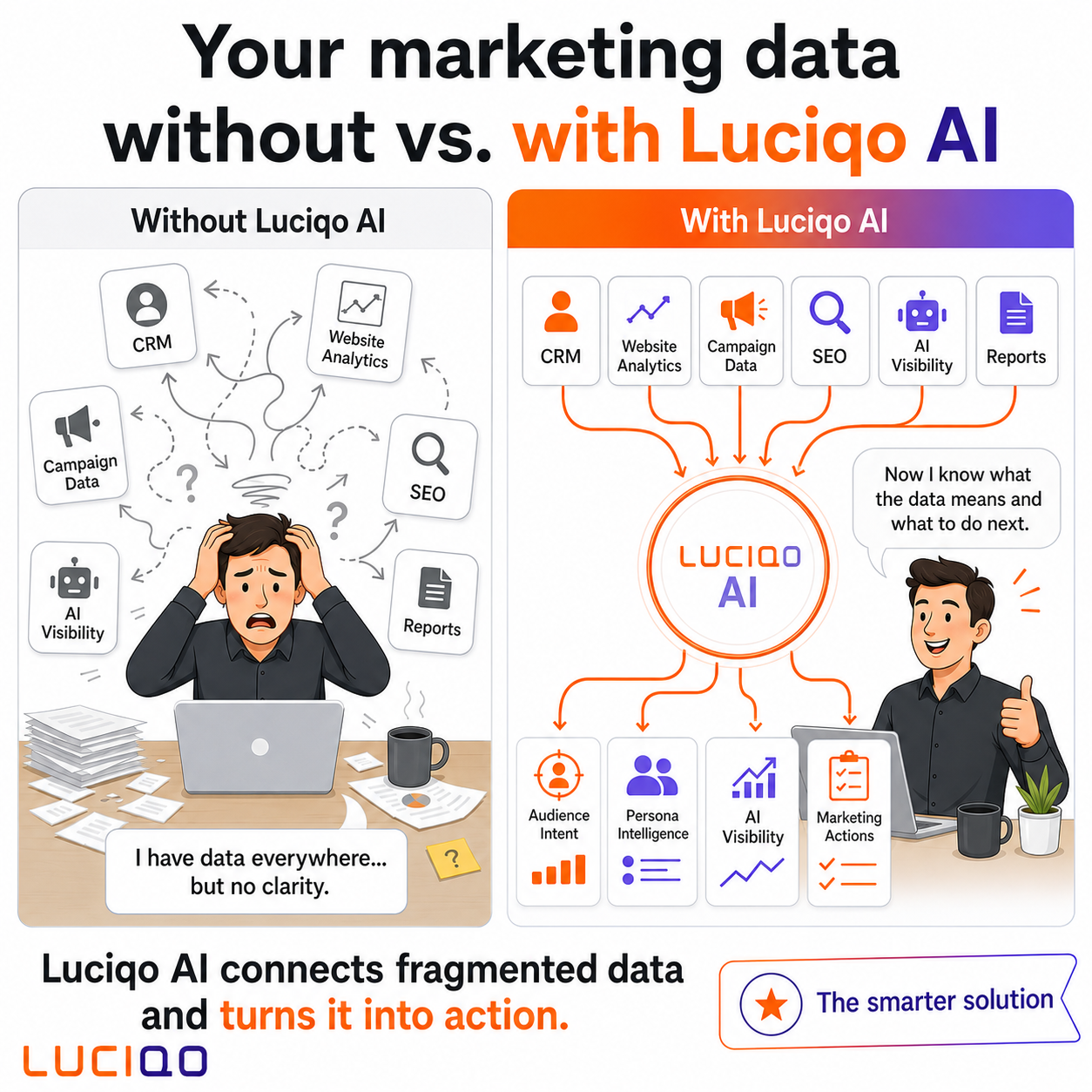
Each system may be useful on its own, but when these data sources are not connected, teams only see part of the picture.
A website analytics platform may show that traffic is increasing, but it may not explain whether those visitors are high-intent prospects. A CRM may show that leads are entering the pipeline, but it may not explain which marketing journeys influenced them. A campaign report may show clicks and impressions, but not whether the audience is moving closer to conversion. An AI visibility report may show whether a brand is being mentioned, but not how that visibility connects to audience intent, positioning or commercial opportunity.
This creates a common problem.
- Businesses have data, but they do not always have intelligence.
- They have dashboards, but not always direction.
- They can see activity, but not always meaning.
Why more dashboards are not the answer
Many businesses try to solve the data problem by adding more tools.
- A new reporting dashboard.
- A new CRM plug-in.
- A new analytics platform.
- A new campaign tracker.
- A new AI visibility tool.
But adding more tools does not automatically create better decisions. In many cases, it adds more complexity.
The issue is not that businesses need more disconnected reports. The issue is that they need a clearer intelligence layer sitting above the data.
That layer needs to answer practical questions, such as:
- Who is engaging with us?
- What are they trying to achieve?
- What stage of intent are they in?
- Which campaigns are attracting the right type of audience?
- How is our brand being represented by AI platforms?
- Which competitors are being mentioned instead of us?
- What content or messaging should we create next?
- Where should the marketing team focus its time and budget?
- This is where Luciqo AI is different.
Luciqo AI is not just another dashboard. It is designed to act as a customised data intelligence layer that helps organisations connect fragmented marketing data and turn it into clearer audience understanding, brand visibility insight and practical marketing actions.
What Luciqo AI does differently
Luciqo AI has been built for the new marketing environment, where visibility no longer depends only on traditional search engines.
Today, potential customers may discover, compare and evaluate brands through AI-generated answers. They may ask ChatGPT for recommendations. They may use Perplexity to research suppliers. They may see summarised answers in Google AI Overviews. They may never reach page one of Google in the traditional way.
This means businesses need to understand not only how they perform in SEO, but how AI platforms understand and describe their brand.
Luciqo AI helps connect this emerging AI visibility layer with wider marketing intelligence.
The platform can support organisations by helping them:
- Understand how their brand is mentioned across AI platforms
- Identify whether competitors are appearing where they are not
- Analyse how AI describes their positioning, services and reputation
- Connect audience behaviour with intent signals
- Generate persona intelligence from available data
- Turn fragmented reports into clearer marketing actions
- Support better content, SEO, GEO and campaign decisions
This combination is important.
Tracking AI visibility alone is useful, but it is not enough.
The real value comes when AI visibility is connected with audience intent, persona intelligence and marketing action.
From fragmented data to audience intent
One of the biggest weaknesses in traditional marketing reporting is that it often focuses heavily on activity.
- Clicks.
- Visits.
- Impressions.
- Open rates.
- Traffic volume.
- Form submissions.
- Keyword positions.
These metrics matter, but they do not always explain intent.
A visitor reading an introductory blog article may be in a very different stage of the journey from someone comparing suppliers, requesting pricing or returning to a service page several times. A lead from one campaign may be highly qualified, while another may never convert. A traffic increase may look positive, but it may not always represent the right audience.
Luciqo AI aims to help organisations move beyond surface-level reporting by identifying patterns that indicate audience intent.
This can help marketing teams understand:
- Which audiences are researching
- Which audiences are evaluating
- Which audiences are closer to buying
- Which content supports trust and validation
- Which messages attract higher-quality prospects
- Which journeys need stronger conversion support
When marketing teams understand intent, they can make better decisions.
They can stop creating content for everyone and start creating content for the right people at the right stage.
Persona intelligence: making data human
Another major benefit of connected data is stronger persona intelligence.
Many businesses still create personas based on assumptions, workshops or generic audience profiles. These can be useful, but they often lack real behavioural evidence.
Luciqo AI is designed to help generate persona intelligence from actual marketing, CRM and website data.
This means businesses can better understand the real people behind the numbers.
Instead of simply seeing “traffic increased by 20%”, a team can begin asking:
- What type of audience is this?
- What problem are they trying to solve?
- What content are they engaging with?
- What objections might they have?
- What level of intent are they showing?
- What message would be most useful to them next?
This makes marketing more human and more commercially focused.
Persona intelligence helps bridge the gap between data analysis and customer understanding. It allows businesses to create messaging, content and campaigns that are more relevant, more targeted and more aligned with real buyer behaviour.
AI visibility is now part of brand visibility
One of the biggest shifts in digital marketing is the rise of AI-driven search and answer engines.
For many years, businesses focused heavily on ranking in search engines. That still matters, but it is no longer the full picture.
AI platforms are changing how people discover information. Instead of showing users a list of links, AI systems often summarise answers, compare options and recommend brands directly.
This creates a new challenge.
Your business may have a good website, strong content and positive customer outcomes, but if AI platforms do not understand your brand clearly, you may be invisible in the answers that matter.
Luciqo AI helps businesses analyse their presence across AI platforms and understand:
- Whether the brand is being mentioned
- Which prompts or topics trigger mentions
- How the brand is described
- Which competitors appear more frequently
- What sentiment or positioning is associated with the brand
- Where content gaps may be limiting visibility
- What actions could improve AI search performance
This is the foundation of Generative Engine Optimisation, or GEO.
GEO is about helping AI platforms better understand, trust and reference your brand. It is not about manipulating AI systems. It is about making your digital footprint clearer, more consistent and more useful.
Why connected intelligence improves marketing decisions
When data sources are disconnected, marketing decisions often become reactive.
- Teams may create content because competitors are doing it.
- They may run campaigns without fully understanding intent.
- They may focus on channels that generate activity but not qualified demand.
- They may report on metrics without knowing what actions should follow.
Connected intelligence changes this.
When CRM, analytics, campaign data, SEO insight and AI visibility are interpreted together, marketing teams can make more informed decisions.
- They can identify which audiences are most valuable.
- They can see which content supports the customer journey.
- They can understand where visibility is weak.
- They can prioritise actions based on commercial opportunity.
- They can align marketing activity with real buyer intent.
This is why Luciqo AI has been built as more than a reporting tool.
The goal is not simply to show more data.
The goal is to help businesses understand what the data means and what to do next.
Practical marketing actions, not just insight
Insight is only valuable if it leads to action.
A common problem with many analytics tools is that they provide information but leave teams unsure what to do with it.
Luciqo AI is designed to help turn complex datasets into practical marketing actions.
For example, the platform can support decisions around:
- Which content should be created next
- Which buyer personas should be prioritised
- Which AI visibility gaps need attention
- Which competitors should be monitored
- Which service pages need clearer positioning
- Which topics could improve brand discoverability
- Which campaigns are attracting higher-intent users
- Which messages should be strengthened across the customer journey
This makes the platform useful not only for reporting, but for planning, strategy and execution.
The future of marketing belongs to businesses that understand their data
The next phase of marketing will not be won by the businesses with the most data.
It will be won by the businesses that can understand their data faster, connect it more intelligently and act on it with confidence.
Marketing teams need to know how audiences behave, what they intend to do, how the brand is perceived, where competitors are gaining visibility and how AI platforms are shaping discovery.
That requires more than isolated reports.
It requires a connected intelligence layer.
Luciqo AI brings together audience intent, persona intelligence, AI visibility analysis and marketing action planning into one clearer framework.
For businesses dealing with fragmented marketing data, this can make a significant difference.
Because data on its own does not create growth.
Clarity does.
And Luciqo AI is built to turn fragmented data into clarity, intelligence and action.
Ready to go?
Book a demo with our team to see how Luciqo measures your brand in AI.