
Why High Google Rankings No Longer Guarantee Website Traffic
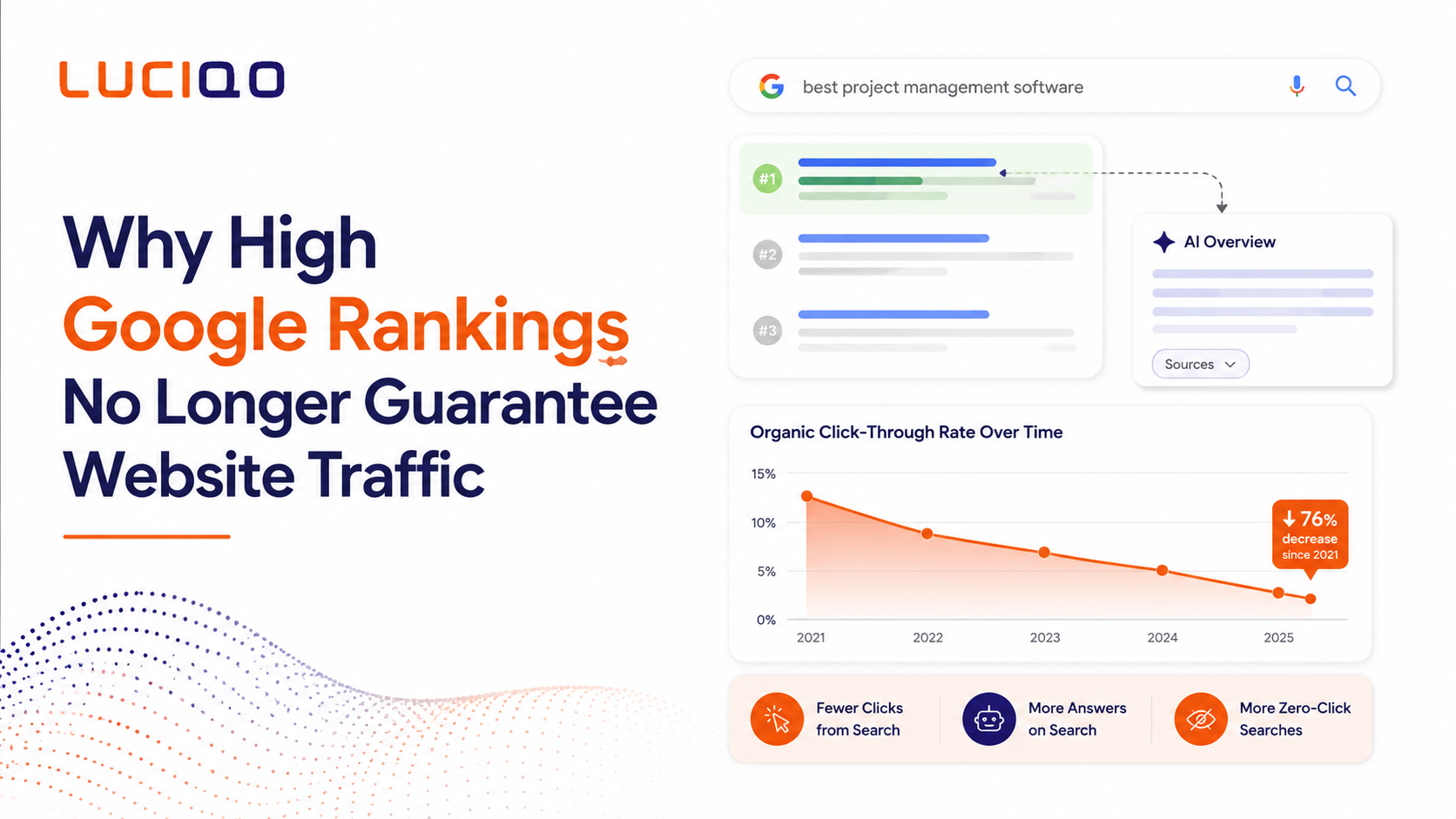
A strong Google ranking used to be one of the clearest signs that an SEO strategy was working.
If a page appeared near the top of the search results, businesses could usually expect more visibility, more clicks and, ideally, more enquiries or sales.
That relationship is becoming less predictable.
Today, search engines increasingly provide answers directly within the results page. Users may see featured snippets, knowledge panels, local listings, product information, AI-generated summaries and other rich results before they reach a traditional website link.
As a result, a business can maintain strong rankings while still seeing organic traffic decline.
This does not mean SEO is no longer valuable. It means businesses need a broader definition of search visibility and a more complete strategy for turning visibility into commercial outcomes.
The rise of zero-click search
A zero-click search happens when a user finds the information they need without visiting another website.
For example, someone searching for opening hours, a simple definition, a product comparison or a quick answer may be able to resolve their question directly from the search results.
AI-powered search experiences are expanding this behaviour. Instead of showing only a list of links, search platforms can now summarise information, combine insights from multiple sources and present a direct response to the user.
This creates a significant change for businesses.
Your content may still contribute to the answer, but the user may never visit your website.
That makes traditional metrics such as rankings and organic sessions less reliable when viewed in isolation.
Why rankings and traffic are beginning to separate
Historically, SEO performance was often measured through a relatively simple journey:
- A page ranked for a target keyword.
- A user clicked the result.
- The user visited the website.
- The business attempted to convert the visit.
That journey now includes more potential stopping points.
A search engine may answer the question directly. An AI assistant may summarise the topic. A local result may provide the phone number, location and opening times. A review platform may influence the customer before the brand’s website is ever considered.
This means a high-ranking page can still be visible while receiving fewer clicks.
For marketing leaders, the key question is no longer simply:
Are we ranking?
It is:
Are we being seen, trusted and chosen across the full search journey?
Traditional SEO still matters
It would be a mistake to conclude that businesses should move away from SEO.
Search engines still need reliable, well-structured and authoritative content to understand a website. Strong technical foundations, useful pages, relevant keywords, internal linking and quality backlinks remain important.
The difference is that SEO now operates within a wider discovery environment.
Businesses need to optimise not only for traditional search rankings, but also for answer engines and generative search systems.
That is where AEO and GEO become increasingly relevant.
What is Answer Engine Optimisation?
Answer Engine Optimisation, or AEO, focuses on making content easier for search engines and digital assistants to use when responding to direct questions.
The aim is to provide clear, relevant and well-structured answers.
This often involves:
- Identifying the questions customers actually ask
- Answering those questions early and directly
- Using clear headings and logical page structures
- Including concise definitions and summaries
- Supporting claims with credible evidence
- Adding structured data where appropriate
AEO is especially useful for search behaviour involving questions such as:
- What is the best option for my business?
- How does this service work?
- What does this term mean?
- How much does this solution cost?
- What are the risks or benefits?
Content that answers these questions well has a better chance of appearing in featured snippets, voice search responses and other answer-focused search experiences.
What is Generative Engine Optimisation?
Generative Engine Optimisation, or GEO, focuses on improving how a brand’s content is understood and potentially referenced by AI-generated search results.
Generative systems do not simply match a keyword to a page. They attempt to interpret meaning, identify trustworthy sources and combine information into a useful response.
For businesses, this creates a new visibility challenge.
It is no longer enough to publish a page that uses the right keyword. Content also needs to demonstrate expertise, clarity, relevance and trust.
A strong GEO approach may include:
- Building clear topical authority
- Publishing original and genuinely useful insights
- Maintaining consistent brand and service information
- Making expertise easy to verify
- Using examples, evidence and transparent reasoning
- Structuring content so key points are easy to extract
- Strengthening mentions across credible third-party sources
GEO should not be treated as a replacement for SEO. It is an extension of search strategy for an environment where AI systems increasingly influence what users see.
SEO, AEO and GEO: how they work together
These three disciplines are closely connected, but they are not identical.
SEO helps a website rank in traditional search results.
AEO helps content provide direct answers to specific questions.
GEO helps content and brand expertise become more visible within AI-generated responses.
A strong modern search strategy should account for all three.
For example, a business software company might publish a guide targeting the keyword “best CRM for small businesses.”
Traditional SEO would help the guide rank.
AEO would ensure the page clearly answers related questions, such as what features matter, how much a CRM costs and how different options compare.
GEO would strengthen the page’s authority by including original analysis, transparent criteria, practical examples and information that generative systems can interpret confidently.
Together, these elements improve the likelihood that the brand is visible across multiple stages of the search experience.
Traffic is no longer the only measure of search performance
Organic traffic remains important, but it should not be the only metric used to judge success.
As more search journeys take place partly or entirely outside a website, businesses need to consider a wider set of signals.
These may include:
Branded search growth
An increase in searches for your company name can indicate that people are discovering the brand elsewhere and returning with greater intent.
Share of search visibility
This looks at how often your brand appears across relevant topics compared with competitors, rather than focusing on a single keyword position.
Enquiries and conversions
A smaller number of better-qualified visitors may be more valuable than a large volume of low-intent traffic.
Assisted conversions
Search visibility may influence a customer before they convert through another channel, such as direct traffic, email or social media.
Mentions in AI-generated results
Monitoring whether a brand, product or source is referenced in generative answers can provide an early indication of GEO performance.
Engagement with high-value content
Time on page, return visits, downloads and contact actions can show whether the content is attracting the right audience.
The goal is not to stop measuring traffic. It is to understand traffic within a wider commercial context.
How businesses can adapt
The shift towards zero-click and AI-assisted search requires a practical response.
1. Focus on customer questions, not just keywords
Keywords still matter, but they should reflect real customer needs.
Start by identifying the questions prospects ask during sales calls, consultations, product comparisons and onboarding.
These questions often reveal stronger content opportunities than broad, high-volume search terms.
2. Make answers easy to find
Avoid forcing readers to search through long introductions before reaching the main point.
Use clear headings, concise summaries and direct explanations. A reader should be able to understand the core answer quickly, while still having the option to explore the topic in more detail.
3. Demonstrate real expertise
Generic content is easier to produce than ever. It is also easier to ignore.
Businesses can differentiate themselves by adding original experience, informed opinions, practical frameworks, customer insights and clear examples.
The objective is not to publish more content. It is to publish content that is more useful and more credible.
4. Strengthen trust signals
Make it easy for both users and search systems to understand who created the content and why they are qualified to do so.
This may include clear author information, accurate company details, transparent sourcing, case studies, client evidence and well-maintained service pages.
5. Build topic authority
A single article is unlikely to establish expertise on a broad subject.
Create connected content around the commercial questions that matter most to your audience. Link related pages together and ensure each piece contributes to a wider topic.
This helps search engines and AI systems understand the areas in which your brand has genuine relevance.
6. Create a reason to click
When the basic answer is already visible in the search results, the website needs to offer additional value.
This could include:
- A detailed framework
- A downloadable checklist
- A calculator or assessment
- Original research
- A comparison tool
- A practical template
- A personalised recommendation
The content should give users a clear reason to move from a general answer to deeper engagement.
7. Connect search visibility to business outcomes
SEO reporting should not end with keyword positions and traffic charts.
Marketing teams should connect search activity to enquiries, pipeline contribution, sales quality and customer acquisition.
This provides a more accurate picture of whether visibility is creating value.
The commercial risk of ignoring the change
Businesses that focus only on traditional rankings may develop a false sense of security.
A dashboard can show strong keyword positions while actual demand, engagement and conversions weaken.
This creates several risks:
- Marketing teams may continue investing in content that no longer produces meaningful results.
- Competitors may become more visible in AI-generated answers.
- Brand awareness may decline even while rankings remain stable.
- Reporting may overstate performance by focusing on visibility without measuring commercial impact.
The solution is not to abandon existing SEO activity. It is to expand the strategy before the gap between rankings and results becomes harder to ignore.
The opportunity for early adopters
Search is becoming more complex, but that complexity also creates opportunity.
Many businesses are still optimising content almost entirely for traditional keyword rankings. Brands that adapt early can build stronger visibility across search results, answer engines and generative platforms.
The most successful organisations are likely to be those that:
- Understand their customers’ questions
- Publish credible and useful answers
- Build recognisable expertise around key topics
- Measure visibility beyond website traffic
- Create content that supports real commercial decisions
In this environment, the objective is not simply to rank first.
It is to become a trusted source that customers, search engines and AI systems recognise.
Conclusion
High Google rankings are still valuable, but they no longer guarantee website traffic.
As zero-click searches and AI-generated answers become more common, businesses need to look beyond conventional SEO metrics. Rankings should be evaluated alongside brand visibility, answer presence, engagement, conversions and commercial impact.
SEO remains the foundation. AEO and GEO help extend that foundation into the new search landscape.
For business owners and marketing leaders, the priority is clear: create content that is easy to understand, genuinely useful and supported by credible expertise.
Luciqo AI helps businesses assess their current search visibility and develop content strategies designed for SEO, AEO and generative discovery. A search visibility audit can help identify where your brand is performing well, where competitors are gaining ground and what needs to change next.
Ready to go?
Book a demo with our team to see how Luciqo measures your brand in AI.